Small Online Kindnesses
  • Small Online Kindness Generator
  • Subscribe
  • Submit

How We Wrote the Book: Slow Waves of ColorĀ 

1/3/2014

1 Comment

 
Writing a book with someone (Reshan) who is a great project manager has its benefits for someone (Steve) who is used to writing alone and used to writing short essays or blog posts. You can sprint through a short essay or blog post; you can't sprint through a book. So you need to find ways to maintain your energy, the quality of your writing, and even your interest. 

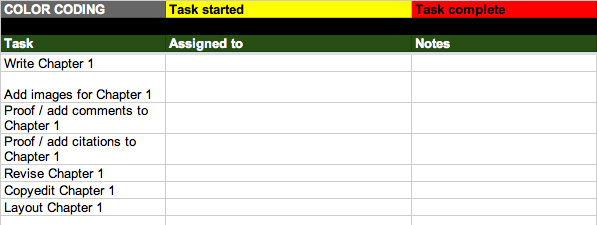
Reshan structured our work using simple tables in shared Google Docs, and he invented a way for us to track of our progress with a color-coding system. For example, here's the way Reshan might have organized the work that went into our first chapter:
Picture
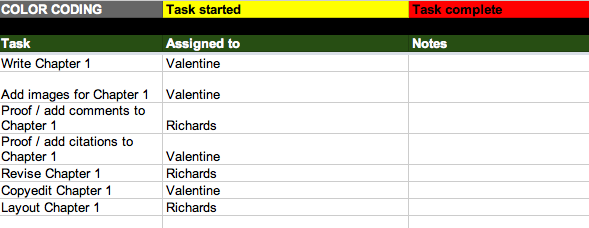
Once this table was functional, and shared between us, we could choose tasks for ourselves or assign each other tasks:
Picture
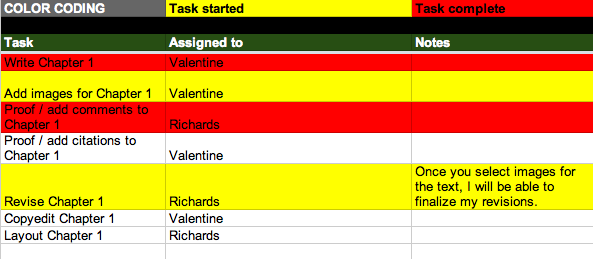
As we started working and adding color to the table, our momentum became visible.  We could easily see that we were heading in the right direction. At the same time, the colorless cells became opportunities. If either one of us had some time on our hands, we could look at the blank spaces and see if we could work toward our collective goal -- completion of the table.  
Picture
We used this simple organizing principle to drive the completion of dozens of small projects in support of our big project. Whether we were working on writing, editing, citations, permissions, or gathering endorsements, slow waves of color crashing across tables reminded us that we were making progress -- that we were actually writing a book.    
1 Comment

One Year Ago Today...

1/1/2014

1 Comment

 
Picture
...Steve and I both published posts on our respective blogs about our plans to turn an idea into reality. At the time we weren't sure what it was going to be, but we were sure that it was going to be something. Today we met face-to-face — one of maybe only four or five times in the whole year that we met in person about this project. We're doing some final copy-editing, and in a couple of days we'll be submitting the iBooks Author file to the iTunes store for review. We plan to make the book available at the end of January.

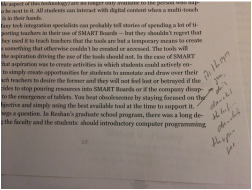
I wanted to take a photograph of us at our "meeting," but I forgot. So instead I am providing a photograph of one of Steve's comments on a printout of one of the pages he was reviewing. I couldn't understand what he had written, so I took a picture of it with my phone, emailed it to him, and waited for him to explain it to me. He got back to me, via email, saying that it was a quote from Antoine de Saint-Exupery that he thought was interesting and connected to a portion of a chapter:

If you want to build a ship, don't drum up people together to collect wood and don't assign them tasks and work, but rather teach them to long for the endless immensity of the sea.
You'll have to download the book to see if and where this quote gets placed.
1 Comment

How We Wrote the Book: The Formula

1/1/2014

1 Comment

 
As promised, here's a post about the process we used to produce our book in spite of the many competing demands on our time (more to come).   

Once Reshan and I decided that we were going to write this book, we settled in to a disciplined routine.  We treated the project like a job, which meant showing up to work on it at regular intervals outside the hours we spend at work or with our families.  We worked during the proverbial "nights and weekends," or more precisely, mornings and weekends.  What we found was a pretty simple formula: 40 to 60 minutes each morning, six days a week, week after week, makes a book.  

It's a shame that writing is often wrapped up in mystical garb -- as if you have to be divinely inspired to write poems or short stories or articles or books.  Feeling energized / inspired is certainly helpful when you sit before a blank screen or page.  But if you feel like you can't approach blank screens or pages or canvases unless you feel a certain way (i.e., inspired) then you probably won't fill in that blankness with any regularity, which means you won't create with any regularity.  

On good days, writers write.  On the other days, they type. Words add up to sentences add up to paragraphs add up to chapters.  40 to 60 minutes each morning, six days a week, week after week, makes a book.  

Maybe we're just getting older, or maybe the fact that we don't have much time has caused us to develop a pragmatic approach to our passion projects. But we certainly weren't alone in 2013; in fact, our process was similar to the one championed all over the Internet this past year.    

2013 was the year where people like Austin Kleon (of Steal Like an Artist fame) and Maria Popova (of Brainpickings.com fame), two great sources of online leadership in the creative mentorship category, started to really hammer home the idea that writers and artists need routines.  

Popova, in a great post on creativity, quoted Chuck Close: “Inspiration is for amateurs — the rest of us just show up and get to work.”

And Kleon, whose "something small, every day" approach mirrors our own, quoted Oliver Burkman (quoting Chuck Close) in another post: 
[T]he daily rituals and working routines of prolific authors and artists – people who really do get a lot done – very rarely include techniques for ‘getting motivated’ or ‘feeling inspired’. Quite the opposite: they tend to emphasise the mechanics of the working process, focusing not on generating the right mood, but on accomplishingertain physical actions, regardless of mood. Anthony Trollope wrote for three hours each morning before leaving to go to his job as an executive at the post office; if he finished a novel within a three-hour period, he simply moved on to the next. (He wrote forty-seven novels over the course of his life.) The routines of almost all famous writers, from Charles Darwin to John Grisham, similarly emphasise specific starting times, or number of hours worked, or words written. Such rituals provide a structure to work in, whether or not the feeling of motivation or inspiration happens to be present. They let people work alongside negative or positive emotions, instead of getting distracted by the effort of cultivating only positive ones. ‘Inspiration is for amateurs,’ the artist Chuck Close once memorably observed. ‘The rest of us just show up and get to work.’
What will you be working on in 2014?  Let us know . . . maybe we can help. 
1 Comment

How We Wrote the Book: Introduction

12/29/2013

0 Comments

 
Reshan and I are as busy as any other folks who work in schools and have growing families. If you are one of us, or married to one of us, you know what that means -- we race from one end of the day to the other and then fall into bed until the alarm throws us back into the ring.  

A common question we've been hearing lately, then, is, "how did you find the time to write a book?"

Over the next few weeks, I will answer this question as systematically as I can. I'm very proud of our product, but I am even more proud of our process.  It involves discipline, collaboration, giving, rules, games, friendship, humor, social media, idea capture, momentum indicators, and a bunch of other ingredients. I look forward to sharing . . . after I put the kids to bed.  
0 Comments

Join Steve and Reshan at #EDUCON

12/29/2013

0 Comments

 
Picture
We're going to be facilitating a conversation at Educon 2.6 in Philadelphia, PA on Saturday, January 25th. Our session is titled 'Engaging as Networked Thought Leaders: Let's Write a Book in 90 Minutes!' Our plan is to create an environment where all participants engage in the same type of thought generation, articulation, and sharing that we learned about as we constructed our book (Leading Online). It's a bit ambitious, but we think it will be a lot of fun to try and pull off. You can find out more about our session and the wonderful Educon conference by clicking here.  

0 Comments

Leading Online Book Cover In-Progress

12/28/2013

1 Comment

 
Picture
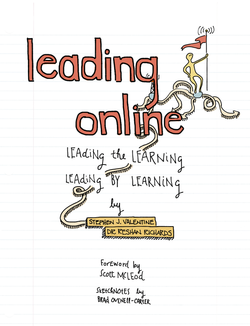
We're putting finishing touches on the book cover. The artwork is by the talented Brad Ovenell-Carter (@braddo on Twitter), who also provides sketchnotes for each chapter throughout the book.

You'll also notice from the cover that Dr. Scott McLeod (@mcleod on Twitter) has done us a great honor by writing  the Foreword and sharing his perspective on the future of leadership.

Please sign up for our mailing list to receive an email as soon as the book is available in the iBook Store.

1 Comment

Join the Mailing List for "Leading Online" Updates

12/23/2013

1 Comment

 
Picture
Next month, Leading Online: Leading the Learning, Leading by Learning will make its way to the iBooks Store. Please subscribe to our Mailing List and connect with us on Twitter, LinkedIn, Facebook, and Google+ for all of the latest news and updates.

Below is more information about this project, which Steve and I have been working on for almost one year. It is entirely self-designed and self-published.

What is our book about?

This is a book about organizational leadership, framed through the lens of school leadership. Published online, in the very world it seeks to describe, this book offers instruction, examples, and a network with which to connect. Reading it and interacting with it will, indeed, help you to build some of the skills needed to thrive in today's rapidly changing leadership landscape.

We both love paper books, but we wrote this electronic book to see if we could make a text that, as much as possible, performs the ideas it expresses. It's best to think of it as a demo. Our goal from the beginning was to demonstrate the potential of what we discuss (technology, the Internet, emerging models of leadership) as our discussion unfolds.

Unperturbed by the rapid development of technologies, the savviest leaders understand that, increasingly, leadership happens in a mix of online and offline spaces. They take this condition as reality, and an inspiring one at that, working to become as adept at leading screen-to-screen as they are at leading face-to-face. In fact, some go even further, planning and maintaining the online aspects of their schools with as much care and expertise as they would a new brick-and-mortar facility.

Regardless of your online orientation, we hope that Leading Online will serve as an essential guide for you if you believe that school doesn't just happen in the buildings we call schools.

Part of the proposed value of Leading Online is the network of leaders it presents through its drop-in contributors. These are leaders you will want to follow and know. These are leaders with whom you will want to connect. Why? Because they are doing interesting work and making that work visible online so that others can learn from it.  At the same time, they ask great questions — also visibly, online — so that others can see them in the act of learning.

They are leaders who, we're guessing, will be doing their most interesting and important work in the near future, making them both established and emerging. You will want to see what they do next. They are seizing the momentum made available to them by advances in technology. You will notice that they understand the fundamentals of leadership but also actively push against and question traditional approaches. Finally, and most important, they understand that relationships mediated by technology can be as kind and humane and generous as face-to-face relationships.

Who are we?

Stephen J. Valentine serves as Assistant Head of Upper School and Director of Academic Leadership at Montclair Kimberley Academy. He blogs at www.refreshingwednesday.com and is the coordinating editor of the Klingenstein Center’s Klingbrief. He is the author of Everything but Teaching (Corwin, 2009). 

Dr. Reshan Richards is the Director of Educational Technology and a Middle School Math Teacher at Montclair Kimberley Academy. He blogs at www.constructivisttoolkit.com and is the creator of the Explain Everything app. He has an Ed.D. from Teachers College, Columbia University, an Ed.M from Harvard University, and a B.A. from Columbia University.

Scott McLeod, J.D., Ph.D. has written the foreword, and we also have contributions from many wonderful educators, innovators, and leaders including Patrick Larkin, Jennie Magiera, Don Buckley, Michelle Cordy, Curt Lieneck, Kristin Swanson, Tejpaul Bhatia, David Malone, Scott Rocco, Nabeel Ahmad, Raul Cuza, and Brad Ovenell-Carter (who did all of the sketch-notes).

- Written by Reshan

1 Comment

Hello World

12/13/2013

1 Comment

 
Picture
We are starting to put some more pieces into place in anticipation of our planned January 2014 release of the book.

1 Comment
Forward>>

    Archives

    February 2015
    December 2014
    October 2014
    June 2014
    April 2014
    March 2014
    February 2014
    January 2014
    December 2013

    RSS Feed

Powered by Create your own unique website with customizable templates.